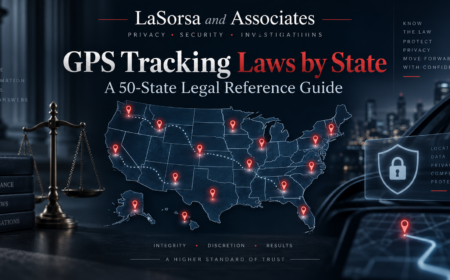
GPS trackers, Bluetooth tracking devices, mobile applications, and vehicle telematics can reveal the location and movements of people, vehicles, and personal property. These technologies have legitimate applications, but their use can also create criminal liability, civil exposure, and significant privacy concerns.
This guide addresses private GPS and electronic location tracking by individuals, businesses, employers, investigators, and security professionals. It identifies the principal tracking-specific or stalking provisions in all 50 states, important consent distinctions, selected exceptions, and effective-date issues.
The National Conference of State Legislatures’ summary of private location-tracking laws provided the starting point. That resource was dated September 13, 2022. This guide incorporates additional statutory research rather than treating that older summary as a current statement of every state’s law.
This is a statutory reference, not a legal opinion about a particular tracking operation. Official legislative sources were prioritized, with accessible reproductions of statutory text used where official access was unavailable. Exceptions are summarized rather than reproduced exhaustively. Applicable court decisions and other privacy laws require separate review.
Understanding the Different Legal Approaches
A tracking-specific law can prohibit unauthorized installation or use without requiring proof of a threatening pattern. A stalking law generally requires additional elements, such as a course of conduct, a particular intent, fear, or emotional distress.
Some states place direct tracking prohibitions inside statutes titled “cyberstalking.” The statute’s title alone therefore does not determine what must be proven. North Carolina is one example.
Consent standards also differ substantially. Depending on the statute, permission may need to come from the person being tracked, the property owner, a vehicle owner, all vehicle owners, a lessor, a lessee, an authorized operator, or every occupant. Tennessee specifies consent from all vehicle owners, while Rhode Island generally specifies consent from the operator and all occupants.
An entry describing a stalking-based restriction does not mean that other tracking is necessarily lawful. It identifies the principal framework addressed in this guide, not a guarantee that no other restriction applies.
Federal Law and Government Tracking
Federal stalking law, 18 U.S.C. § 2261A, can apply to qualifying interstate or electronic stalking when its intent, conduct, and fear or emotional-distress requirements are established. Physically crossing a state line is not the only way its electronic-communications provisions can become relevant.
United States v. Jones, 565 U.S. 400 (2012), held that the government’s attachment of a GPS device to a vehicle and its use to monitor movements constituted a Fourth Amendment search. That decision concerns government searches. It is not a nationwide consent statute governing every private investigator, employer, or individual.
50-State Legal Reference
Alabama
Principal statutes: Ala. Code §§ 13A-6-95 and 13A-6-96.
Alabama prohibits placing a tracking device on another person’s property without the owner’s consent or lawful authority. Second-degree electronic stalking addresses that unauthorized placement and is a Class A misdemeanor.
First-degree electronic stalking adds an intent to surveil, stalk, harass, or pursue another unlawful purpose and is generally a Class C felony. A qualifying protective-order violation increases the classification.
The statutory definition of “owner” includes certain possessory interests. Title ownership alone should not therefore be treated as the complete consent analysis.
Alaska
Principal statute: Alaska Stat. § 11.41.270.
Nonconsensual contact expressly includes following or monitoring someone through GPS or similar technology. It also includes specified installation or use of surveillance devices, including software, involving a person’s residence, vehicle, workplace, telephone, or computer.
Second-degree stalking requires knowingly engaging in repeated nonconsensual contact that recklessly places someone in fear of death or physical injury to themselves or a family member. It is a Class A misdemeanor.
The GPS language is part of a stalking offense, not a separate rule making every nonconsensual tracking event criminal without the remaining elements.
Arizona
Principal statute: Ariz. Rev. Stat. § 13-2923.
A stalking course of conduct can include unauthorized electronic, digital, or GPS surveillance of a person or their internet or wireless activity. The tracking provision addresses surveillance lasting at least 12 continuous hours or occurring on two or more occasions, however short.
The prosecution must also establish the applicable mental-state and emotional-distress or fear elements.
Authorized activities, certain consent-based monitoring, parental or guardian authorization for minors, and constitutionally protected activity are addressed in the exclusions. The duration thresholds alone do not establish a completed stalking offense.
Arkansas
Principal statute: Ark. Code § 5-71-229, including amendments under Act 832 of 2025.
Arkansas includes following, monitoring, observing, or placing someone under surveillance through a device within its stalking framework.
Requirements differ by degree. Second-degree stalking includes a harassing course of conduct and a qualifying terroristic threat. Third-degree stalking can involve a single knowing act that would cause a reasonable person emotional distress and fear for safety.
The statute recognizes a fact-specific affirmative defense for certain professionals, including licensed private investigators, acting reasonably within their duties. This is not an unconditional investigator exemption or a universal GPS-consent offense.
California
Principal statute: Cal. Penal Code § 637.7.
California generally prohibits using an electronic tracking device to determine another person’s location or movements.
The section does not apply when the registered owner, lessor, or lessee of a vehicle consents to its use with respect to that vehicle, or when a law-enforcement agency uses it lawfully.
The device definition concerns equipment attached to a vehicle or another movable thing that reveals location or movement through electronic signals. Violations are misdemeanors and can support professional licensing discipline.
The vehicle-consent exception does not require consent from every occupant.
Colorado
Principal authority: Colo. Rev. Stat. § 13-20-1301; SB 24-011.
Colorado’s 2024 law creates civil liability for nonconsensual installation of a tracking device or application on another person’s property, or causing a device or application to track another person or their property without consent.
Consent can be withdrawn, and continued tracking after revocation can create liability.
Recovery concerns damages proximately caused by the violation, including qualifying noneconomic damages. Exceptions address specified official law-enforcement activity, toll authorities, and parents or guardians tracking their minor children.
This enactment creates a civil claim, not a standalone criminal GPS offense.
Connecticut
Principal statute: Conn. Gen. Stat. § 53a-181f.
Connecticut’s electronic-stalking offense concerns using electronic services, systems, or monitoring systems with intent to kill, injure, harass, or intimidate.
The conduct must satisfy the statute’s surveillance or course-of-conduct requirements and its reasonable-fear or substantial-emotional-distress provisions.
The current offense is a Class D felony. A tracker can be the instrument of electronic stalking, but lack of consent alone does not replace the statute’s intent and harm-related requirements.
Older summaries identifying this provision as a Class B misdemeanor do not reflect the current classification.
Delaware
Principal statute: 11 Del. C. § 1335(a)(8).
Delaware’s invasion-of-privacy statute prohibits knowingly installing an electronic or mechanical location-tracking device in or on a motor vehicle without consent of the vehicle’s registered owner, lessor, or lessee.
Exceptions address lawful law-enforcement use and a parent or guardian monitoring a minor child.
The provision focuses on installation in or on a vehicle, not every possible source of location information. A business or investigator should identify the consenting party’s actual legal relationship to the vehicle before relying on permission.
Florida
Principal statute: Fla. Stat. § 934.425.
Florida prohibits knowingly installing or placing a tracking device or application on another person’s property without consent, and knowingly using one to determine a person’s or their property’s location or movement without consent, subject to exceptions.
Specified divorce and protective-injunction filings create presumptions that prior consent has been revoked.
Exceptions cover conditional parental, caregiver, business, vehicle-related, court-authorized, and official uses. Private investigators cannot simply invoke the general business exception.
The ordinary violation is a third-degree felony. Using the violation to commit or facilitate a statutorily defined dangerous crime increases it to a second-degree felony.
Georgia
Principal statute: Ga. Code § 16-11-62(8).
Georgia specifically prohibits secretly and intentionally placing, or directing another person to place, a GPS or other monitoring device on a vehicle owned or leased by another person without consent when that owner or lessee has obtained a protective order against the person responsible.
This paragraph is narrower than a universal prohibition on unauthorized vehicle tracking. The protective-order relationship is a required element.
Its limited scope does not establish that other covert tracking is lawful. Other potentially applicable stalking and privacy provisions require separate analysis.
Hawaii
Principal statute: Haw. Rev. Stat. § 803-42(a)(8).
Hawaii prohibits intentionally installing or using a mobile tracking device without a search warrant or other court order unless it is installed by, or with consent of, the owner of the property on which it is installed.
That property-owner-consent exception matters for private uses. It is inaccurate to summarize the provision as requiring a court order for every private tracker.
Violation of the applicable prohibition is a Class C felony. The exception concerns ownership of the property carrying the device, not simply ownership of the tracker itself.
Idaho
Principal statute: Idaho Code § 18-7906.
Idaho includes maintaining surveillance through electronic means among forms of nonconsensual contact relevant to stalking.
Second-degree stalking requires a knowing and malicious course of conduct meeting the statute’s serious-alarm, harassment, substantial-emotional-distress, or fear requirements. The offense is a misdemeanor.
Electronic monitoring can therefore support a stalking charge, but the cited provision is not an independent rule under which every nonconsensual GPS installation automatically constitutes stalking. The surrounding conduct, mental state, and impact remain material.
Illinois
Principal statute: 720 ILCS 5/21-2.5.
Illinois generally prohibits using a qualifying electronic tracking device to determine a person’s location or movements. Its definition concerns a device attached to a vehicle.
Exceptions include consent from the registered owner, lessor, or lessee; lawful law-enforcement use; specified business-fleet and government uses; and qualifying manufacturer or subscription telematics systems.
A violation is a Class A misdemeanor.
The fleet exception has ownership and operational requirements. It should not be assumed to cover every vehicle an employee uses, and permission under this provision does not necessarily resolve a separate stalking allegation.
Indiana
Principal statute: Ind. Code § 35-46-8.5-1.
Indiana prohibits knowingly or intentionally placing a tracking device on a person or property owned or used by that person without their knowledge or consent.
The ordinary offense is a Class A misdemeanor, with specified circumstances increasing it to a Level 6 felony.
Exceptions include certain family relationships, ownership or contractual interests, official or court-authorized uses, and disclosed manufacturer equipment. Protective-order limitations can defeat otherwise available family or property-interest exceptions.
Because property merely used by the individual can be covered, the analysis cannot stop at who holds title.
Iowa
Principal statute: Iowa Code § 708.11.
Iowa’s stalking law includes repeated use of a technological device to locate, listen to, or watch someone without authorization or a legitimate purpose. The definition expressly includes GPS devices.
A stalking charge still requires the statute’s purposeful-course-of-conduct and reasonable-fear requirements. Device use alone is not enough.
Using a technological device while committing stalking is a circumstance classified as a Class C felony under the current statute. The important distinction is between an authorized tracking arrangement and technology used as part of prohibited stalking conduct.
Kansas
Principal statute: Kan. Stat. § 21-5427.
A stalking course of conduct expressly includes using an electronic tracking system or acquiring tracking information to determine someone’s location, movements, or travel patterns.
Ordinarily, a course requires two or more acts, although a protective-order branch can apply to a single qualifying act. Different branches have different mental-state and fear requirements.
Certain legitimate-purpose and constitutionally protected activities are excluded.
The tracking language is not limited to the person who physically installs the device. Acquiring tracking information can also be relevant.
Kentucky
Principal statute: Ky. Rev. Stat. § 508.152.
Kentucky distinguishes installation from use. Installation generally requires the owner’s knowledge and consent. For a leased vehicle, the statute also recognizes the lessee or authorized operator.
Tracking the vehicle’s location separately recognizes consent from the owner or authorized operator, or the lessee or authorized operator of a leased vehicle.
Additional prohibitions protect qualifying protective-order beneficiaries and certain crime victims. Exceptions include specified navigation, emergency, diagnostic, theft-recovery, disclosed leasing, parental, and police uses.
The parental exception concerns a parent- or guardian-owned or leased vehicle operated by the minor. The offense is a Class A misdemeanor.
Louisiana
Principal statute: La. Rev. Stat. § 14:323.
Louisiana generally prohibits using an electronic tracking device to determine another person’s location or movements without that person’s consent.
Exceptions include vehicle-owner consent and certain lawful official, commercial, employment, parental, and telematics uses.
The lessor-or-lessee exception also requires consent of the vehicle’s operator. It should not be reduced to lessee consent alone.
When parents are separated or divorced, the parental exception generally requires both parents’ consent unless one has sole custody.
The person-consent rule and the vehicle-related exceptions use different consent standards, making the particular exception important.
Maine
Principal statute: 17-A M.R.S. § 210-A.
Maine’s stalking definition includes following, monitoring, tracking, observing, or surveilling a person through a device or other means. A course of conduct generally requires at least two acts.
Liability depends on the applicable intentional or knowing conduct and the statute’s reasonable-person consequences. Those consequences include serious inconvenience, emotional distress, and specified fears concerning people, property, or animals.
This is a stalking framework rather than a separate blanket private-GPS-installation offense. The device is one component of the overall conduct being evaluated.
Maryland
Principal statute: Md. Code, Criminal Law § 3-802.
Maryland expressly includes using a device to pinpoint or track another person’s location without their knowledge or consent within its stalking framework.
The conduct must still satisfy the statute’s malicious-course-of-conduct requirements and its intent, knowledge, reasonable-fear, or substantial-emotional-distress provisions.
The law excludes specified conduct performed to ensure legal compliance, carry out a lawful commercial purpose, or pursue other activity authorized by law.
Those exclusions require an actual lawful basis. Calling an activity an investigation or a business purpose does not itself establish an exception.
Massachusetts
Principal statutes: Mass. Gen. Laws ch. 265, §§ 43 and 43A.
The principal stalking offense requires a willful and malicious pattern that seriously alarms or annoys and would cause substantial emotional distress, together with a qualifying threat intended to create imminent fear of death or bodily injury.
Criminal harassment under § 43A addresses a willful and malicious pattern that seriously alarms and would cause substantial emotional distress without the same separate threat requirement.
GPS surveillance may be relevant evidence when those elements are established. Neither provision should be presented as making every nonconsensual tracker installation automatically criminal.
Michigan
Principal statute: Mich. Comp. Laws § 750.539l.
Installation requires the knowledge and consent of the vehicle owner or, for a leased vehicle, the lessee.
Tracking its location separately recognizes consent from the owner or authorized operator, or the lessee or authorized operator of a leased vehicle.
Additional restrictions concern protective orders and specified offenders tracking victims or their families. Exceptions address certain telematics, disclosed leasing, parental, official, and licensed-investigator uses.
The investigator exception covers specified purposes and is unavailable for restrained clients or knowingly assisting criminal activity. The ordinary offense is a misdemeanor.
Minnesota
Principal statute: Minn. Stat. § 626A.35.
Minnesota generally restricts installing or using a mobile tracking device without judicial authorization. However, subdivision 2a expressly exempts installation by, or with consent of, the owner of the object carrying the device.
That exception makes a blanket statement that every private GPS tracker requires a court order incorrect.
Other exceptions address specified law-enforcement circumstances. Knowingly violating the section is a misdemeanor.
Permission should be tied to the object being tracked and the applicable exception, not assumed from ownership of the tracking hardware.
Mississippi
Principal statute: Miss. Code § 97-3-107.
Mississippi’s stalking statute addresses a purposeful course of conduct directed at a particular person, or a qualifying credible threat, when the actor knows or should know it would cause a reasonable person to fear for personal safety, another person’s safety, or damage to property.
A course of conduct involves multiple acts and can include following or other prohibited contact.
Covert tracking may be evidence within that analysis, but the cited law is not a device-specific installation-consent statute. Aggravating circumstances and protective-order violations require separate attention.
Missouri
Principal statutes: Mo. Rev. Stat. §§ 565.227 and 565.260.
As of the research date, the existing second-degree stalking provision addresses purposefully disturbing another person through a course of conduct, or following with intent to disturb. GPS-related conduct must be assessed under the version actually in force.
Missouri has enacted a separate vehicle-tracking offense, § 565.260, scheduled to take effect July 1, 2027.
It addresses knowingly installing, concealing, or placing a device on a vehicle without all owners’ consent to monitor or follow occupants, subject to exceptions.
That future prohibition is not yet effective in September 2026. The legislature also displays future versions of related stalking provisions.
Montana
Principal statute: Mont. Code § 45-5-220.
Montana’s definition of monitoring expressly includes electronic, digital, GPS, and similar surveillance technology.
Stalking requires a purposeful or knowing course of conduct involving two or more acts that the actor knows or should know would cause a reasonable person to fear for their own or another person’s safety or suffer substantial emotional distress.
The tracking method is therefore part of a broader stalking inquiry, not a complete offense by itself. The course of conduct, mental state, and statutory consequences must also be established.
Nebraska
Principal statutes: Neb. Rev. Stat. §§ 28-1336 through 28-1339.
Effective July 18, 2026, Nebraska prohibits specified nonconsensual installation of tracking devices or applications, causing them to track another person or their property without consent, and failing to remove them after consent is revoked.
The law addresses revocation associated with notice, marital proceedings, and qualifying protection orders.
Exceptions include conditional parental, caregiver, business, vehicle-related, court-authorized, and official uses.
The private-investigator exception requires property-owner consent and specified investigative purposes. Protective-order and criminal-purpose exclusions apply. The general business exception is not an unrestricted substitute for the investigator requirements.
Nevada
Principal statute: Nev. Rev. Stat. § 200.930.
Nevada prohibits knowingly installing, concealing, or placing a mobile tracking device in or on another person’s motor vehicle without the knowledge and consent of an owner or lessor.
The text uses “owner or lessor,” not a general exception for anyone operating the vehicle.
Its express exception concerns law-enforcement installation that complies with constitutional and state-law requirements.
A first offense is a misdemeanor, a second a gross misdemeanor, and a third or later offense a category C felony. The provision does not supply a general private-investigator exemption.
New Hampshire
Principal statutes: N.H. Rev. Stat. §§ 644-A:4 and 644-A:6.
New Hampshire prohibits a private individual from nonconsensually placing or installing an electronic device on another person or their property and obtaining location information through it.
Exceptions include a parent or guardian tracking a minor, a guardian tracking a protected adult, and qualifying court-ordered monitoring.
An injured person may bring a civil action for a violation.
The chapter separately regulates government conduct. Its Class B misdemeanor provision should not be indiscriminately applied to private defendants. The private restriction and civil-remedy provisions need to be read together.
New Jersey
Principal statute: N.J. Stat. § 2C:12-10.
New Jersey’s stalking definition includes repeatedly following, monitoring, observing, or surveilling someone through a device or other means.
The offense requires a purposeful or knowing course of conduct that would cause a reasonable person to fear for their own or another person’s safety or suffer emotional distress. Repeated conduct ordinarily means two or more occasions.
Tracking can therefore be part of stalking even without physically following the target.
The statute should not be summarized as requiring vehicle-owner consent alone or making every isolated tracker installation stalking.
New Mexico
Principal statute: N.M. Stat. § 30-3A-3.
New Mexico includes monitoring or surveillance by electronic or other means within its stalking framework.
The offense requires knowingly pursuing a pattern of conduct without lawful authority, with the specified intent to cause apprehension of death, bodily harm, sexual assault, confinement, or restraint.
A pattern generally involves two or more acts on different occasions.
The statute’s lawful-authority language includes defined employment-related or constitutionally protected conduct, but it should not be treated as a blanket exception for anything described as an investigation. Purpose and legal authority remain central.
New York
Principal statute: N.Y. Penal Law § 120.45.
For subdivision 2 of fourth-degree stalking, “following” expressly includes unauthorized tracking through GPS or another device.
That subdivision requires material harm to mental or emotional health and that the actor was previously clearly told to stop, along with the section’s intentional-course-of-conduct and no-legitimate-purpose requirements.
Other branches address different harms and do not necessarily contain that same stop-notice requirement. A blanket statement that GPS tracking becomes unlawful only after a warning would therefore be misleading.
Fourth-degree stalking is a Class B misdemeanor.
North Carolina
Principal statute: N.C. Gen. Stat. § 14-196.3(b)(5).
North Carolina prohibits knowingly installing, placing, or using an electronic tracking device without consent to track another person’s location.
Although located in the cyberstalking statute, this paragraph directly prohibits tracking. It does not require importing the threats or repeated-message elements of other paragraphs.
Exceptions address specified vehicle-owner or lessee, parental, guardian, fleet, creditor, employer-provided device, requested-service, manufacturer, licensed-investigator, court-authorized, and official uses.
Several exceptions have protective-order or other conditions. The investigator exception is limited to authorized licensed activity and retains protected-person restrictions.
Violations of the section are Class 2 misdemeanors.
North Dakota
Principal statute: N.D. Cent. Code § 12.1-17-07.1.
North Dakota expressly includes unauthorized tracking through GPS, a robot, or other electronic means within stalking when it would cause a reasonable person fear, intimidation, or harassment and serves no legitimate purpose.
This tracking branch should not be rewritten as necessarily requiring the same repeated-contact pattern as other branches. The offense requires intentional stalking.
A statutory defense is available for a qualifying licensed private investigator or peace officer acting within the scope of employment.
That defense is role- and activity-specific, not an exception for every person hired to investigate.
Ohio
Principal statute: Ohio Rev. Code § 2903.216.
The version effective March 20, 2025 prohibits specified nonconsensual installation or use of tracking devices or applications to track another person or their property and addresses failure to remove them after consent is revoked.
Divorce and protection-order provisions contain service-based revocation and 72-hour requirements.
Detailed exceptions cover certain parental, caregiver, business, vehicle-related, official, and investigator uses.
The investigator exception requires property-owner consent, a listed investigative purpose, and compliance with protective-order and criminal-purpose restrictions.
An additional amendment takes effect October 6, 2026. It is not the governing version on the September 7 research date.
Oklahoma
Principal statute: Okla. Stat. tit. 21, § 1173.
“Following” includes tracking someone’s movements or location through GPS or another monitoring device without that individual’s consent, whether performed directly or on another person’s behalf.
Stalking still requires the applicable willful, malicious, repeated conduct and the reasonable-person and actual-victim impact elements.
The statute excludes lawful device use and specified vehicle-creditor or dealer uses connected to lawful action after default, with express written consent of the owner or lessee.
The creditor provision is conditional. It does not authorize unrestricted tracking simply because a vehicle is financed.
Oregon
Principal statute: Or. Rev. Stat. § 163.715.
Oregon prohibits knowingly affixing a GPS device to a motor vehicle without the owner’s consent.
The ordinary offense is a Class A misdemeanor, increasing to a Class C felony in specified prior-stalking or court-order circumstances.
Exceptions address police installation under a warrant or court order and devices affixed to vehicles operated by a motor carrier.
The section specifically concerns affixing a GPS device and defines it by reference to GPS coordinates. Its wording should not automatically be extended to every location-sharing application or non-GPS tracking technology without further analysis.
Pennsylvania
Principal statute: 18 Pa. Cons. Stat. § 2709.1.
Pennsylvania’s stalking statute addresses a course of conduct or repeated acts, including following without proper authority, under circumstances demonstrating an intent to cause reasonable fear of bodily injury or substantial emotional distress.
Covert GPS surveillance can be relevant when those elements are established, but the cited provision is not a standalone vehicle-owner-consent statute.
The analysis concerns purpose, authority, and the overall conduct rather than ownership alone. A proposed tracking-specific bill should not be substituted for the law actually in force.
Rhode Island
Principal statute: R.I. Gen. Laws § 11-69-1.
Rhode Island generally prohibits knowingly installing, concealing, placing, or using an electronic tracking device in or on a motor vehicle without consent of the operator and all occupants when the purpose is monitoring or following occupants.
Exceptions address specified official uses, limited parental or guardian tracking, stolen property, qualifying business fleets, financing, rental or manufacturer systems, and insurance uses.
The parental exception is narrowly framed around an owned or leased vehicle used solely by the minor, with protective-order restrictions.
This is materially different from an owner-only consent rule.
South Carolina
Principal statutes: S.C. Code §§ 16-3-1700 and 16-3-1730.
South Carolina’s stalking definition concerns a pattern of words or conduct serving no legitimate purpose that is intended to cause, actually causes, and would cause a reasonable person to fear specified harms to themselves, family members, or property.
Related harassment provisions address other prohibited patterns.
GPS monitoring may be relevant to that analysis, but this framework is not a standalone rule making every unconsented placement stalking.
Proposals for a separate unlawful-tracking offense should not be cited as enacted law without confirming passage and an effective date.
South Dakota
Principal statute: S.D. Codified Laws § 22-19A-1.
South Dakota prohibits specified willful and malicious repeated following or harassment.
It also addresses credible threats made with intent to create fear of death or great bodily injury and certain repeated harassment through electronic or other communications.
A tracking pattern may be relevant, but a tracker is not itself proof of every required element.
The cited section is not a universal vehicle-installation consent rule. Whether an arrangement constitutes stalking requires examination of the conduct, intent, and applicable statutory branch.
Tennessee
Principal statute: Tenn. Code § 39-13-606.
Tennessee generally prohibits knowingly installing, concealing, or placing an electronic tracking device in or on a motor vehicle without consent of all owners for the purpose of monitoring or following an occupant.
A lessor must obtain the lessee’s consent.
Exceptions concern lawful law-enforcement activity, limited parental or guardian use involving an owned or leased vehicle used solely by the minor, and locating specified stolen property. Manufacturer-installed systems are treated separately.
The ordinary violation is a Class A misdemeanor.
The all-owners requirement is not the same as Rhode Island’s operator-and-all-occupants standard.
Texas
Principal statute: Tex. Penal Code § 16.06.
Texas prohibits knowingly installing an electronic or mechanical tracking device on a motor vehicle owned or leased by another person. The offense is a Class A misdemeanor.
Affirmative defenses include effective owner or lessee consent, specified assistance to law enforcement, and qualifying licensed-investigator activity.
The investigator defense requires the statutory written-consent or court-order conditions. Where entry onto private property is necessary, the applicable written permission for entry also matters.
Licensing alone is insufficient. The law separately excludes a peace officer’s installation in the lawful performance of official duties.
Utah
Principal statute: Utah Code § 76-12-305.
Utah’s current 2026 provision covers unauthorized placement of trackers on vehicles, a person’s body, tangible property, or property under their physical control, and unauthorized use of tracking applications on devices in their possession or control.
It also addresses intentional continued tracking after permission is revoked and the actor knows of the revocation.
A violation is a Class A misdemeanor.
Exceptions are category-specific, and the vehicle-tracking investigator exception includes protective-order verification requirements.
Older references to former § 76-9-408 or vehicle-only wording need updating.
Vermont
Principal statutes: 13 V.S.A. §§ 1061 and 1062.
Vermont defines a course of conduct to include two or more acts of following, monitoring, observing, or surveilling someone through a device or other means.
Stalking involves purposefully engaging in such a course when the actor knows or should know it would cause a reasonable person to fear for safety or suffer substantial emotional distress.
GPS monitoring can fall within the conduct being evaluated, but the broader elements still matter.
A proposal for a separate vehicle-tracking prohibition is not a substitute for the enacted stalking provisions.
Virginia
Principal statute: Va. Code § 18.2-60.5.
Virginia criminalizes intentionally deceptive, nonconsensual installation of an electronic tracking device, including causing its installation, together with using it to track another person’s location. It is a Class 1 misdemeanor.
Exceptions address specified official, parental, vulnerable-adult, fleet, service-provider, and registered-investigator activities.
The investigator exception requires property-owner consent and ordinary professional activity. It does not apply when the client is subject to a qualifying protective order or the investigator knows or should know the service is sought to assist a crime.
The deception and use elements should be preserved in any summary.
Washington
Principal statute: RCW 9A.46.110.
Washington’s current stalking law expressly addresses knowingly installing or monitoring an electronic tracking device without consent to locate another person.
The harm requirement can be satisfied when knowledge of the tracker would reasonably produce substantial emotional distress or fear. Actual discovery is not invariably required.
The definition includes software. Specified official, guardian, parental, fleet, and organizational exceptions apply, and a licensed-investigator defense is available.
The employer or organizational device exception is limited to recovering lost or stolen items.
Former RCW 9A.90.130 was repealed and should not be cited as the current standalone provision.
West Virginia
Principal statute: W. Va. Code § 61-2-9a.
West Virginia’s stalking offense addresses a course of conduct directed at another person with intent to cause fear for personal safety, fear for others’ safety, or substantial emotional distress.
A course includes two or more acts of following, monitoring, observing, or surveilling through a device or other means, including conduct carried out through another person. Harassment is addressed separately.
Tracking can be part of the prohibited pattern, but this is not an unconditional GPS-installation-consent offense.
Protective orders, repeat offenses, and other aggravating circumstances can materially change exposure.
Wisconsin
Principal statute: Wis. Stat. § 940.315.
Wisconsin prohibits placing a GPS device or GPS-equipped device on a vehicle owned or leased by another person without that person’s consent.
It also prohibits intentionally obtaining another person’s movement or location information generated by a device placed without that person’s consent.
A violation is a Class A misdemeanor.
Exceptions include specified telematics installations, owner-approved insurance uses, official law enforcement, parental or guardian uses, lienholder repossession, and qualifying employer or business vehicles.
The information-acquisition clause reaches beyond the person who physically installs the device.
Wyoming
Principal statute: Wyo. Stat. § 6-2-506.
Wyoming expressly includes unauthorized electronic, digital, or GPS surveillance of a person, or their internet or wireless activity, within conduct that can constitute stalking.
The offense still requires intent to harass and a course of conduct reasonably likely to harass under the statutory definitions. An unapproved tracker does not automatically establish every element.
Wyoming also has jurisdiction provisions addressing conduct or effects involving a victim in the state.
An interstate tracking operation should therefore not be evaluated solely under the law of the state where the device was installed.
Practical Considerations Before Relying on an Exception
As a risk-management practice, document who authorized the tracking, their authority over the person or property involved, the permitted purpose and duration, who may access the information, and how revocation will be handled.
Written authorization is a prudent default, but it cannot substitute for obtaining consent from additional people where a statute requires it.
Do not assume that marriage, joint ownership, parenthood, employment, a client request, or an investigator’s license supplies blanket authority.
The provisions above illustrate meaningful limits. Indiana restricts certain family and property-interest exceptions. Texas imposes specific investigator-defense requirements. Virginia excludes certain protective-order clients from its investigator exception.
For interstate activity, obtain advice addressing installation, monitoring, the target’s location, and the states where conduct or effects occur.
Review the version effective on the relevant date, not merely the first version displayed on a legislative website. Missouri’s future July 1, 2027 provision and Ohio’s October 6, 2026 amendment illustrate why that distinction matters.
Legal Notice
This material is provided for general educational and professional-reference purposes and is not legal advice.
It is not a complete treatment of surveillance, privacy, employment, computer-access, wiretap, evidence, or private-investigator law. Statutory compilations and reproductions can lag amendments, and judicial interpretation can affect application.
Qualified counsel should verify the relevant law and facts before tracking is conducted or this guide is relied upon as a compliance determination.
References
National Conference of State Legislatures: Private Use of Location Tracking Devices—State Statutes
https://www.ncsl.org/technology-and-communication/private-use-of-location-tracking-devices-state-statutes
Federal stalking law: 18 U.S.C. § 2261A
https://uscode.house.gov/view.xhtml?edition=prelim&num=0&req=granuleid%3AUSC-prelim-title18-section2261A
United States v. Jones, 565 U.S. 400 (2012)
https://www.govinfo.gov/content/pkg/USREPORTS-565/pdf/USREPORTS-565-400.pdf
Alabama: Electronic stalking legislation
https://www.legislature.state.al.us/pdf/SearchableInstruments/2023RS/HB153-enr.pdf
Alaska: Alaska Stat. § 11.41.270
https://law.justia.com/codes/alaska/title-11/chapter-41/article-2/section-11-41-270/
Arizona: Ariz. Rev. Stat. § 13-2923
https://www.azleg.gov/viewdocument/?docName=https%3A%2F%2Fwww.azleg.gov%2Fars%2F13%2F02923.htm
Arkansas: Ark. Code § 5-71-229
https://law.justia.com/codes/arkansas/title-5/subtitle-6/chapter-71/subchapter-2/section-5-71-229/
California: Cal. Penal Code § 637.7
https://leginfo.legislature.ca.gov/faces/codes_displaySection.xhtml?lawCode=PEN§ionNum=637.7.
Colorado: SB 24-011
https://leg.colorado.gov/bills/sb24-011
Connecticut: Conn. Gen. Stat. § 53a-181f
https://law.justia.com/codes/connecticut/title-53a/chapter-952/section-53a-181f/
Delaware: 11 Del. C. § 1335
https://delcode.delaware.gov/title11/c005/sc07/index.shtml
Florida: Fla. Stat. § 934.425
https://www.flsenate.gov/Laws/Statutes/2026/934.425
Georgia: Ga. Code § 16-11-62
https://law.justia.com/codes/georgia/title-16/chapter-11/article-3/part-1/section-16-11-62/
Hawaii: Haw. Rev. Stat. § 803-42
https://data.capitol.hawaii.gov/hrscurrent/Vol14_Ch0701-0853/HRS0803/HRS_0803-0042.htm
Idaho: Idaho Code § 18-7906
https://law.justia.com/codes/idaho/title-18/chapter-79/section-18-7906/
Illinois: 720 ILCS 5/21-2.5
https://www.ilga.gov/legislation/ilcs/documents/072000050K21-2.5.htm
Indiana: Ind. Code § 35-46-8.5-1
https://law.justia.com/codes/indiana/title-35/article-46/chapter-8-5/section-35-46-8-5-1/
Iowa: Iowa Code § 708.11
https://www.legis.iowa.gov/docs/code/708.11.pdf
Kansas: Kan. Stat. § 21-5427
https://www.ksrevisor.gov/statutes/chapters/ch21/021_054_0027.html
Kentucky: Ky. Rev. Stat. § 508.152
https://apps.legislature.ky.gov/law/statutes//statute.aspx?id=54106
Louisiana: La. Rev. Stat. § 14:323
https://legis.la.gov/Legis/Law.aspx?d=78422
Maine: 17-A M.R.S. § 210-A
https://legislature.maine.gov/statutes/17-A/title17-Asec210-A.html
Maryland: Criminal Law § 3-802
https://mgaleg.maryland.gov/mgawebsite/Laws/StatuteText?article=gcr&enactments=true§ion=3-802
Massachusetts: Mass. Gen. Laws ch. 265, § 43
https://malegislature.gov/Laws/GeneralLaws/PartIV/TitleI/Chapter265/Section43
Michigan: Mich. Comp. Laws § 750.539l
https://www.legislature.mi.gov/Laws/MCL?objectName=mcl-750-539l
Minnesota: Minn. Stat. § 626A.35
https://www.revisor.mn.gov/statutes/cite/626A.35
Mississippi: Miss. Code § 97-3-107
https://law.justia.com/codes/mississippi/title-97/chapter-3/section-97-3-107/
Missouri: Mo. Rev. Stat. § 565.227
https://revisor.mo.gov/main/OneSection.aspx?hlr=y§ion=565.227
Missouri: Mo. Rev. Stat. § 565.260, scheduled to take effect July 1, 2027
https://revisor.mo.gov/main/OneSection.aspx?section=565.260
Montana: Mont. Code § 45-5-220
https://mca.legmt.gov/bills/mca/title_0450/chapter_0050/part_0020/section_0200/0450-0050-0020-0200.html
Nebraska: Neb. Rev. Stat. § 28-1337
https://nebraskalegislature.gov/laws/statutes.php?statute=28-1337
Nebraska: Neb. Rev. Stat. § 28-1338
https://nebraskalegislature.gov/laws/statutes.php?statute=28-1338
Nevada: NRS Chapter 200, including § 200.930
https://www.leg.state.nv.us/NRS/NRS-200.html
New Hampshire: RSA Chapter 644-A
https://gc.nh.gov/rsa/html/lxii/644-a/644-a-mrg.htm
New Jersey: N.J. Stat. § 2C:12-10
https://law.justia.com/codes/new-jersey/title-2c/section-2c-12-10/
New Mexico: N.M. Stat. § 30-3A-3
https://law.justia.com/codes/new-mexico/chapter-30/article-3a/section-30-3a-3/
New York: N.Y. Penal Law § 120.45
https://www.nysenate.gov/legislation/laws/PEN/120.45
North Carolina: N.C. Gen. Stat. § 14-196.3
https://ncleg.net/EnactedLegislation/Statutes/HTML/BySection/Chapter_14/GS_14-196.3.html
North Dakota: N.D. Cent. Code Chapter 12.1-17
https://www.legis.nd.gov/cencode/t12-1c17.pdf
Ohio: Ohio Rev. Code § 2903.216, effective March 20, 2025
https://codes.ohio.gov/assets/laws/revised-code/authenticated/29/2903/2903.216/3-20-2025/2903.216-3-20-2025.pdf
Ohio: Ohio Rev. Code § 2903.216, amendment effective October 6, 2026
https://codes.ohio.gov/assets/laws/revised-code/authenticated/29/2903/2903.216/10-6-2026/2903.216-10-6-2026.pdf
Oklahoma: Okla. Stat. tit. 21, § 1173
https://law.justia.com/codes/oklahoma/title-21/section-21-1173v2/
Oregon: ORS Chapter 163, including § 163.715
https://www.oregonlegislature.gov/bills_laws/ors/ors163.html
Pennsylvania: 18 Pa. Cons. Stat. § 2709.1
https://www.legis.state.pa.us/WU01/LI/LI/CT/HTM/18/00.027.009.001..HTM
Rhode Island: R.I. Gen. Laws § 11-69-1
https://webserver.rilegislature.gov/statutes/title11/11-69/11-69-1.HTM
South Carolina: S.C. Code Title 16, Chapter 3
https://www.scstatehouse.gov/code/t16c003.php
South Dakota: S.D. Codified Laws § 22-19A-1
https://sdlegislature.gov/Statutes/22-19A-1
Tennessee: Tenn. Code § 39-13-606
https://law.justia.com/codes/tennessee/title-39/chapter-13/part-6/section-39-13-606/
Texas: Tex. Penal Code § 16.06
https://texas.public.law/statutes/tex._penal_code_section_16.06
Utah: Utah Code § 76-12-305
https://le.utah.gov/xcode/Title76/Chapter12/C76-12-S305_2026050620260901.pdf
Vermont: 13 V.S.A. § 1061
https://legislature.vermont.gov/statutes/section/13/019/01061
Virginia: Va. Code § 18.2-60.5
https://law.lis.virginia.gov/vacode/title18.2/chapter4/section18.2-60.5/
Washington: RCW 9A.46.110
https://app.leg.wa.gov/rcw/default.aspx?cite=9A.46.110
West Virginia: W. Va. Code § 61-2-9a
https://code.wvlegislature.gov/61-2-9A/
Wisconsin: Wis. Stat. § 940.315
https://docs.legis.wisconsin.gov/statutes/statutes/940/II/315
Wyoming: Wyoming Statutes, Title 6, including § 6-2-506
https://wyoleg.gov/statutes/compress/title06.pdf